InStat hockey explained: the Index, the cost and what counts as good
InStat Hockey (now Hudl Instat) gives every player one score per game with an Index formula weighing time on ice and 10 possession outcomes. Hudl publishes no InStat price; its own Club Ice Hockey plans run $400 to $1,600 per team a year. Nobody publishes a “good” Index score.
Updated · By Giuseppe Gaspari, Founder · Sources checked and relinked
InStat gives a club one score, built for the staff. Shift Excellence gives your family its own OVR and a Game Report, built for parents, from games you already play.
Start your 7-day free trialWhat InStat hockey is (and that it is now Hudl Instat)
InStat is a video-and-data analytics platform used across pro and elite youth hockey. It tracks far more than the box score: every possession gets tagged to an outcome and tied to the clip. Hudl acquired InStat, so you will now see it branded as Hudl Instat; the hockey product and its Index score didn't change. It is typically licensed by clubs, which is why access usually comes through your team rather than a personal login. Hudl's own product page claims a database of over 500,000 matches, 70,000 teams and 60,000 players across its basketball and ice hockey coverage combined.
How much does InStat hockey cost
Hudl doesn't publish a price for InStat itself. The Instat product page sends every visitor to a sales contact form: “Tell us about your organization and a Hudl representative will contact you.” A separate outlet, HoopBrief, reached the same conclusion in 2026: “Hudl InStat has no published price, and there is no reliable public range for it either.” Anyone quoting you a specific InStat number is estimating, not reading it off Hudl's site.
What Hudl does publish is pricing for its separate Club Ice Hockey video platform, which isn't the same product as InStat's analytics. Treat the table below as “the only numbers Hudl shows publicly,” not an InStat price list:
| Tier | Price | Video storage |
|---|---|---|
| Bronze | $400 / team / year | 50 hours |
| Silver | $1,000 / team / year | 100 hours |
| Gold | $1,600 / team / year | 200 hours |
What is a good InStat index
This is the question we couldn't find a straight answer to anywhere, including InStat's own site, so we aren't going to invent one. There is no published “good” Index number, by position, age or league. What InStat does publish is how the number is built: the sum of points from 10 possession outcomes (7 count as positive, 3 as negative), multiplied by a time-on-ice coefficient. A player who logs more than 20 minutes in a game gets that sum multiplied by 1.045; a player under 10 minutes gets it multiplied by 0.955. The result is one number for one game, shaped as much by role and ice time as by skill.
How parents get access to a report
Most parents don't buy InStat directly; the program does. If your player is at a CSSHL academy or heading toward the WHL Draft, ask the program whether it uses InStat. Here is the usual path:
Ask your coach or team admin
whether your club carries InStat/Hudl Instat and how parents get a player report.Get the report
usually a PDF or a shared link, straight from the club.Forward it to Shift Excellence
and we read it into a plain-language Game Report automatically.Check your player's percentile in the app
to see how that game stacks up against their own division and position, not a single unexplained number.
The hockey Instat stats that matter most to a parent
An InStat report is dense. For a developing player, these are the ones worth reading first, by position:
- Shot attempts and dangerous shots: volume, and how often it comes from a real scoring area, not just goals.
- Puck battles won versus lost: compete level, made measurable.
- Zone entries and exits: can your player move the puck cleanly under pressure?
- Passes and pass accuracy: playmaking and decision-making.
- Time on ice per shift: usage, and the same number that moves the Index coefficient above.
- Faceoffs: for centers, a quick read on one specific skill.
Read the numbers for the position and the age, not in a vacuum. Our hockey stats explained guide breaks down which stats matter at which age.
The problem with InStat hockey alone
InStat is a strong snapshot of one game. It doesn't synthesize a single development rating, doesn't tell you what to work on, and does not show an arc across a season. Parents end up with a stack of dense PDFs and a number with no published scale behind it.
How Shift Excellence turns an InStat report into a plan
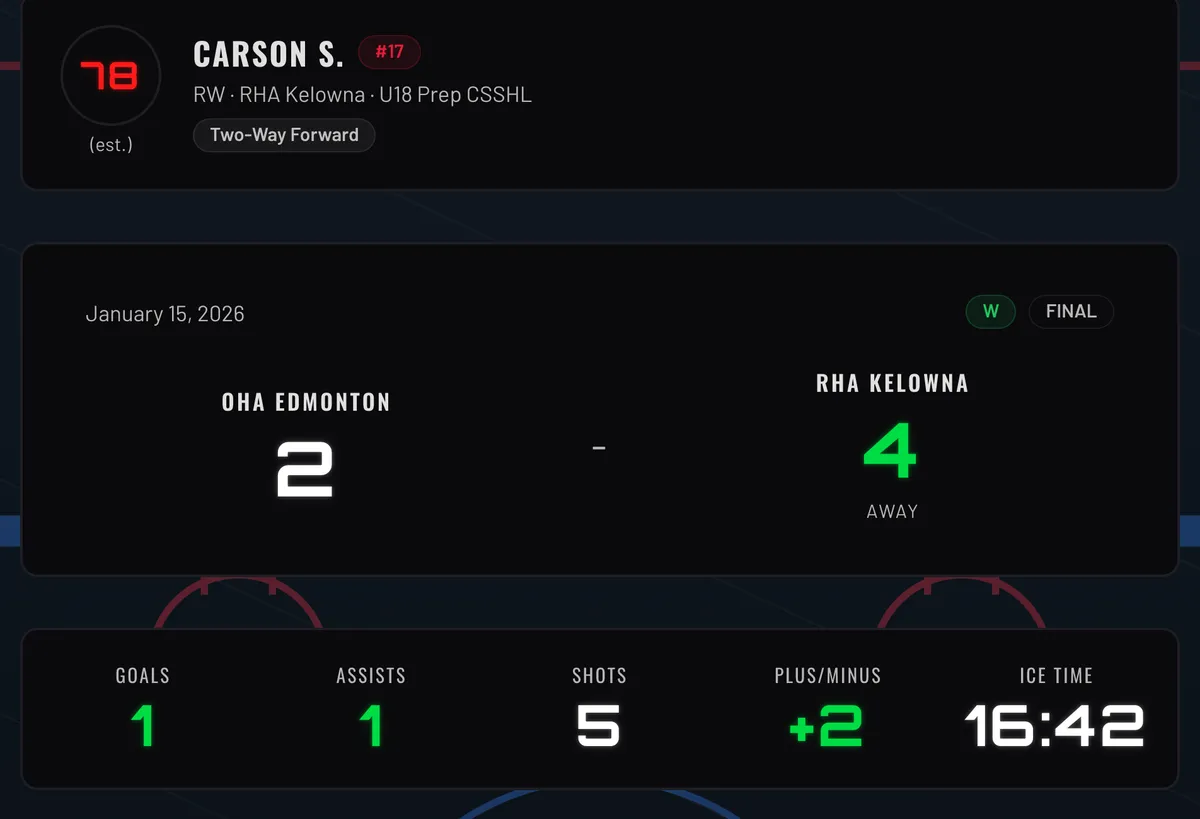
Forward your player's InStat report and Shift Excellence reads it automatically, folds it into a coach-style Game Report, and uses it to sharpen the OVR rating, which is scored against your player's own league and division instead of a number nobody has defined. The dense PDF becomes one clear picture of what to work on next, every game.
Which hockey stats source fits your situation
| Your situation | What we would do |
|---|---|
| Your club has InStat / Hudl Instat | Forward the report; upload it for a plain-language Game Report and OVR update. |
| Your league has no InStat | Use league game data or a manual box score instead; the app still builds a full report. |
| You just want to know if a score is good | Compare it to your own player over time, not a number nobody has published. |
| You want cost figures for a budget conversation | Use Hudl's own published Club tiers ($400 to $1,600 per team a year); ask Hudl directly for an InStat quote. |
Upload your InStat report, get a Game Report
Forward the PDF and see your player's stats turned into a plan, with a percentile you can actually read.
Common questions
InStat hockey FAQ
Frequently Asked Questions
Sources
- Hudl Club ice hockey tiers: Hudl pricing (as of Nov 2026)
- Instat database size and contact-only pricing: Hudl Instat (as of Nov 2026)
- InStat Index formula and ice time coefficients: InStat (archived Aug 2022) (as of Nov 2026)
- No published Instat price: HoopBrief (as of Nov 2026)
Get the Shift Excellence app
Read any report, InStat or not, as one clear picture of what your player should work on next.